
Introduction
A regular evening ritual assists in developing good sleeping habits and aids you and your body in settling down from the busyness of the day.
A calming routine that is expected assists you and your body in developing a sense of anticipation for sleep and regulates the body’s internal circadian clock, alleviates stress, and improves the quality of your rest.
The development of a regular evening routine provides a strong biological signal to help you to fall asleep quickly, sleep more soundly, and wake feeling rested, thereby assisting you to function more effectively during the day.
Roles of an Evening Routine:
Internal Clock Regulation: Consistently performing specific behaviours or habits daily help adapts your body’s natural sleep-wake (circadian) Cycle to the timing of the natural Daylight hours, resulting in the proper release of hormones necessary for sleep.
State of Relaxation: The incorporation into your evening routine of calming behaviours, such as reading, stretching, and/or meditation, will assist you in Relaxing and relieving many of the stresses and anxieties caused by the day’s events and to quiet your mind.
Sleep Signal: The sequence of familiar behaviours that you follow each evening (e.g., dimming the lights, creating a tech-free area in your home and taking a warm bath) creates a Sleep Signal for you that tells your brain and body it is time to prepare for sleep.
Reduced Stimulants: By not exposing your body to an overabundance of stimulus such as Blue Light from electronic screens or overstimulating activity prior to sleep will help your body not to produce the Sleep Hormone Melatonin, which is required for a restful Night’s Sleep.
Improved Quality of Sleep: A well-developed evening routine will improve your quality of Sleep by allowing you to fall asleep faster, to stay asleep longer, to awaken fewer times during the night and to awaken feeling refreshed when you rise in the morning.
Evening Habits Explained
In order to ease your body into sleeping, your nightly routine will be performed in a consistent manner each night.
Nightly routines help to sleep better, alleviate stress, and get you more focused on the next day by creating a transition between work and relaxation through activities such as turning down the lights, limiting your use of screens, performing light exercises, writing a journal, making plans for the next day and eating healthy meals.
A nightly routine will also help to mitigate the effects of decision fatigue and help to prepare you for an effective start to the next day.
Your nightly routine should prevent things that may interfere with your ability to get to sleep like having a lot of caffeine late in the day, having a large meal or doing a strenuous workout close to bedtime.
Components of a Healthy Evening Routine:
Wind Down and Disconnect
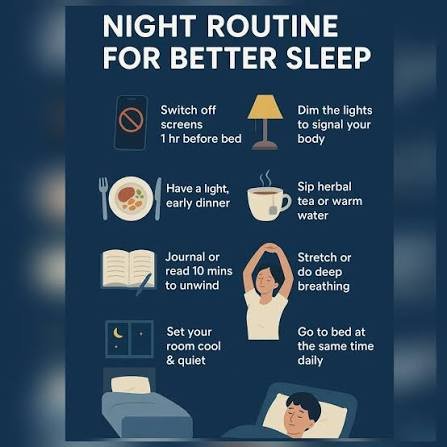
Reduce light levels and store phones/screen devices for at least 30-60 minutes before sleeping, allowing for melatonin (sleeping hormone) production.
Perform Light Movement
Gentle stretching or a leisurely walk is relaxing for the body; however, you should not do vigorous exercise if you are trying to go to sleep.
Have Mindful Eating and Drinking
Eat your last large meal 2-4 hours before sleeping. Avoid foods that are heavy, spicy, too much liquid, sugar and late caffeine or alcoholic beverages.
Prepare for Tomorrow
Write down the things you need to do tomorrow and how you are going to do them in order to clear your mind for a less stressful morning.
Relax and Reflect
Journaling, reading, taking a warm bath, or listening to peaceful music can all assist you to reflect on your day and to relax.
Create a Sleep Sanctuary
Create an environment for sleeping that is dark, quiet, and cool in your bedroom.
Screen Cut-Off
To achieve optimal sleep quality, the practice of limiting screen time before going to bed is highly recommended.
Research has shown The blue wavelength of light emitted from electronic devices such as phones, tablets, computers, and televisions inhibits melatonin production, thereby delaying one’s ability to develop a natural sleep pattern and negatively impact overall sleep quality.
To help the brain prepare itself for sleep, it is ideal that individuals turn off all screens at least one hour before going to bed.
Instead of engaging with electronic devices, using the time before sleep to read, meditate, or perform light stretching can aid in the transition from a state of activity to a state of restfulness.
Establishing habits of limiting screen time before bed will promote deeper sleep, greater energy levels, and increased ability to concentrate during daily activities.
Calming Activities
Incorporating Calming Activities into Your Evening Routine
Integrating calming activities into your evening routine is key to transitioning both mentally and physically into the calm state of mind and body required for sleep. Calming activities for the evening help both the mind and body relax; they reduce your body’s level of stress, slow down your heart rate, and prepare your nervous system for relaxation
. Calming activities can include reading a physical book, journaling your thoughts, meditating or practicing mindfulness, gentle stretching, taking a warm bubble bath, and listening to soft and soothing music.
Calming activities signal your brain that it is time to relax (i.e., your brain’s melatonin production and circadian rhythms will be supported) from overstimulation from screens or stressful tasks (which can disrupt your sleep). A 15- to 30-minute period of relaxation during your evening routine will greatly enhance both how fast you fall asleep, as well as the quality of your sleep (including length of sleep and restoration).
As you continue to perform calming activities in the evening, you are creating an established pre-sleep pattern that will allow you to fall asleep quickly and awaken feeling refreshed. Therefore, performing calming activities in the evening has a direct effect on enhancing the quality of your sleep; additionally, performing calming activities also reduces feelings of anxiety, increases feelings of well-being, and helps to create a well-balanced lifestyle.
Sleep Preparation
Pre-sleep preparation is about developing healthy habits and creating an ideal setting to communicate to your body that it is time to begin resting so that you can achieve the deepest and most restorative sleep possible.
To develop successful pre-sleep preparation, you should develop the habit of going to bed and waking up at the same time every day; dim your room lights as close to bedtime as possible; keep your bedroom cool, quiet, and comfortable..
To help avoid interruptions in your sleep cycle, you should avoid eating large meals, consuming caffeinated and/or alcoholic beverages, and using any type of electronic digital screen before going to bed; you can create a relaxing environment before bedtime by engaging in activities such as reading, writing in a journal, practicing meditation, or gently stretching your body.
There are additional environmental preparations that can be made by using blackout window coverings, eliminating or reducing potential noise in your bedroom, and establishing a good mattress and pillow support system to facilitate the best rest possible.
All of these combined efforts assist in regulating your body’s natural day/night cycles (circadian rhythms), producing melatonin, and reducing the level of stress that you experience as you attempt to fall asleep and remain asleep throughout the night.
Consistent pre-sleep preparation establishes better energy levels and improves focus and productivity during the day while minimizing the likelihood of feeling fatigued and experiencing mood shifts. Making pre-sleep preparation an intentional part of your nightly routine allows you to create better sleeping habits, promote your overall health and well-being, and provide a fully rested and renewed mind and body.
Consistency Benefits
Consistent evening routines help individuals establish a healthy sleep pattern and provide an improved night’s sleep. When an individual has the same set of bedtime activities every night, it is imprinted onto their brain as a triggering mechanism to begin preparing for sleep.
Having a consistent bedtime and wake time allows your body’s circadian rhythms to become more regulated. This allows your body to fall asleep quickly and awaken naturally at the appropriate time.
A consistent evening routine establishes a mental order whereby your brain is familiar with and does not require time to reorganize itself to sleep, thus reducing the amount of mental clutter and confusion the brain experiences when going to bed at different times. As a result, consistent evening routines promote melatonin secretion, allowing for a higher level of deep sleep and recovery.
Additionally, having a consistent evening routine helps prevent sleep disorders such as insomnia and waking up often during the night. Additionally to sleep, regular evening routines create regular patterns of positive changes within each of our daily lives continuing through each day.
They also create an opportunity for increased focus and productivity throughout your day, by creating a sense of routine and control over your day, which in turn, creates increased overall balance in your life, decreased anxiety levels and increased mental clarity.
Practicing consistent habits on a daily basis, even simple habits, has a long-term positive effect on an individual’s physical and emotional well-being.
Thus, developing a healthy and productive routine for going to bed will enable you to establish healthy sleep patterns and develop a long-term commitment to your overall health, productivity and enjoyment in life.
Conclusion
Establishing a regular routine before bedtime is important for better sleep; it informs the body that it should be winding down, assisting to establish circadian rhythms, reducing stress levels, and helping to fall asleep more rapidly and achieve deeper, restorative sleep by performing calming activities that do not involve screens, such as reading or breathing deeply, allowing for greater energy and productivity for the following day.
Takeaways
Signals Your Body: A routine provides a consistent cue for your brain and body to begin preparing to go to sleep.
Regulates The Circadian Rhythm: Establishing a routine will help both the body’s internal clock align with each other so that melatonin is released naturally.
Sleep Latency Is Reduced: Your body will have a smoother transition from being alert to going to sleep.
Quality Of Sleep Is Increased: A bedtime routine will improve the quality of sleep and provide deeper sleep that is less interrupted.
Stress Is Decreased: Activities that calm or relax the mind and body (like stretching, reading, or meditating) aid in releasing any stresses experienced throughout the day during a bedtime routine.