Introduction
Daily reflection is metacognition—it allows individuals to reflect on their past decisions and assess patterns, biases, and results.
By 2025, a number of behavioral psychologists believe this daily reflection process leads to actionable wisdom and minimizes the likelihood of an individual making mistakes through “autopilot,” as is typical in a high-stress situation.
By implementing a daily reflection feedback loop, the individual can move from reactionary behavior to intentional evidence-based decision-making.
Daily reflection is an important habit because it provides a clearer understanding of oneself, one’s thoughts and actions, and one’s experiences.
By taking time each day to pause and assess “what worked” and “what didn’t work,” as well as how previous choices resulted in current outcomes, daily reflection allows individuals to become more aware of themselves and less impulsive in their decisions and responses.
Using past learnings and experiences to inform their responses, individuals can become calmer, clearer thinking, and better at making decisions, both personally and professionally.
Reflection Habit
A habit of reflecting on your actions is one way to develop a structured and ongoing review process for daily learning opportunities and trends. In 2025, experts in behavior stated that reflecting on your experiences is one of the most important phases of your overall advantage, as it breaks the cycle of “automatic” operation or decision-making, which drives about 40% of the time spent on tasks.
Core Reflective Constructs
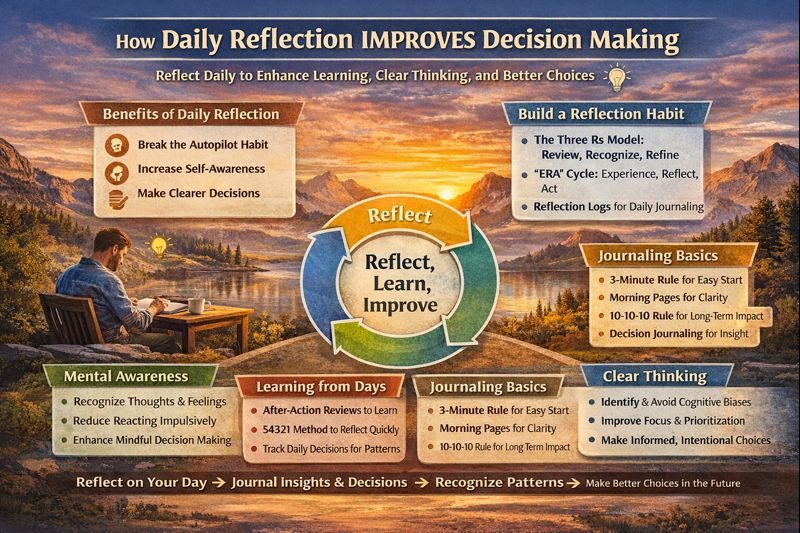
The Three Rs Model: An easy-to-follow, three-minute model that consists of a review of your events (what happened), recognition or understanding of what was learned (what did you learn), and refinement or development (what will you do differently in the future).
The “ERA” Model: A straightforward cycle of experience, reflection, and action. It takes advantage of being able to engage in reflective activities while also ensuring you act on your insights through your physical behavior.
Questioning Yourself Metacognitively: Daily self-assessment by applying systematic interrogative techniques (i.e., what assumptions, if any, am I making? What advice would I give to someone else if they were in this situation?) in order to improve your own decision-making. Sequence of Behaviours for Integration of Behaviours
Morning Strategic Planning Sessions: High-performing individuals often spend 15 minutes at the beginning of their day simulating possible actions with their mind based on their resources before taking action.
Reflection Logs: Keeping a written or recorded account of the recurring patterns in one’s decisions and the outcomes associated with each pattern, this practice can reduce errors in decision-making by as much as 20%.
10-10-10 Rule: Take a minute to stop and think about how a decision may affect you, as well as what impact that decision will have on your future for 10 minutes, 10 months, or 10 years (the goal is to reduce the impulse reaction that may occur in the initial moments after the decision).
Mental Awareness
Individuals who are aware of their own mental well-being are able to recognize their thoughts, feelings, and behavior in the present.
This awareness helps them to make better choices because they are aware of how their feelings, stress, or assumptions about things may influence them. Individuals who are aware of their mental state will become aware of what they do instead of reacting automatically.
It gives them the opportunity to think before they act on impulse and consider their options carefully. By practicing daily reflection, it allows individuals to create time and space for them to think without judgement about the thoughts that go through their heads.
As time goes on, they begin to see patterns in how they think negatively, react emotionally, respond in a habitual way, and understand how to control their behavior, have emotional stability, and be clear. It enhances the ability to focus on what they want out of life through elimination of mental noise and gives them the ability to think logically about the options available.
By becoming more aware of their thought processes through mental awareness, individuals have more control over their mindsets, decreased stress levels, and more quality decisions in their personal and professional lives.
Learning From Days
The act of daily reflection enables individuals to utilize their own observations and experiences each day to create a database that can be used in future performance evaluations.
Data-driven self-analysis is becoming the norm for optimizing cognitive performance and avoiding the “failure to learn” approach by 2025.
Between 2022 and 2025, research into the use of experience versus wisdom indicates that simply gathering experience does not help develop one’s capability to make sound judgments, but through intentional & deliberate reflection on the experiences gained, they can develop wisdom from that.
After-Action Review (AAR)—adapted from military strategy—is a daily practice that requires individuals to ask themselves four questions: What was supposed to happen? What actually happened? Why was there a difference? What could I have learned from?
The process of closing the feedback loop—analyzing today’s “misses”—will minimize similar logical mistakes made in subsequent days and shorten the time frame for acquiring complex task-based knowledge.
Pure-Micro Journaling: writing a single sentence about the major decision point of each day creates an outline for the future, providing an overall picture of where a person is in maturity, which is difficult to recognize or track.
Journaling Basics
The principles of journaling are straightforward practices, with the primary goal of getting the information and thoughts out of your head so you can see them and be able to think about them better.
As of 2025, most people will agree that how you do it is much more important than getting it done perfectly. Your journal is not meant to be a polished product or professionally done—it should be an ongoing, “messy” dialogue between yourself and yourself.
Your Journaling Practice
3-Minute Rule: This guideline states to set a three-minute timer when journaling (or doing a journal-like activity), as you can stop once the alarm rings to take away the pressure, making the practice of journaling easier to do daily.
Morning Pages: Write three pages of a stream of conscious thoughts in gouache. Write first thing in the morning. This practice helps to remove “brain fog” and create a more open, relaxed, and receptive environment for yourself.
54321 Method: The 54321 method is an easy, minimalist ritual to follow at night before you go to bed. You create a bullet-point list of 1 thing that feeds your soul, 2 things you want less of in your life, 3 things you appreciate about your life, 4 things you are going to do tomorrow, and 5 things that are on your mind.
Decision Journaling: Decision journaling refers to creating a record of any major decision you make and your anticipated results, followed by the reason you made that decision.
Then, after some time has passed, you will be able to look back on that decision journal and identify any logic errors or cognitive biases associated with your decision.
Tips for Better Journaling in 2025
Writing It Down vs. Using Technology: Using paper-and-pencil journals allows you to stimulate extra parts of your brain and create deeper reflection, which will ultimately help you remember what you have written better.
Digital applications can be advantageous for tracking ongoing, recent patterns in your life, which can lead to greater understanding and meaning.
Clear Thinking
The act of logically processing information, concentrating on the most critical aspects of that information and processing it without being impacted by any emotional or distracting influence, and making decisions based on facts is what we refer to as clear thought.
Clear thought is essential to accurate problem-solving, decision-making, and the overall development of an individual.
Practitioners utilize methods such as reflective practice and journal keeping as tools to develop their ability to think clearly, allowing them to reflect on the ways in which they think and identify patterns of behavior and decision-making.
A person may have difficulty objectively assessing a situation, which leads to poor decision-making and heightened levels of anxiety due to stress and/or overanalyzing or continuous distraction. Having a clear thought on a particular subject allows an individual to remove themselves from their current circumstance, objectively evaluate the barriers presented, and also evaluate multiple different points of view before taking action.
By continually using the tools and strategies of mindfulness, intentional breaks, and reflection on the actions, individuals will eventually cultivate an increase in their ability to think clearly.
Once developed, an individual will be more likely to focus on what is most important, properly prioritize their tasks, and minimize the chances of acting on impulse.
In addition, an individual will develop their emotional intelligence by learning that their feelings will influence their actions and how to respond emotionally to another person.
Conclusion
We can reflect on a daily basis on our experiences to achieve greater understanding of how to make more effective decisions in the future.
The process of creating this reflective practice has evolved into a key tool to help individuals navigate through the rapidly changing landscape of information that exists today.
Through the habit of periodically reviewing our decisions, we reduce our dependence on faulty gut feelings, clarify our priorities on what we want to achieve, and help to build a more disciplined and objective way of thinking!