Introduction
The comfort zone is the range of activities, relationships, or environments that we feel relaxed enough to be in control of our own behavior and feel fully engaged with the environment and those around us. Although it reduces our uncertainty, it also limits us in terms of our capability to grow beyond this defined area and increase in knowledge, skill, and experience.
Research on human behavior in psychology has demonstrated that it is when we engage in behavior slightly outside our existing environment that we can begin to develop, develop, and/or develop new behaviors. If we remain comfortable for too long, we risk becoming stagnant, developing a fear of change, and missing out on some great opportunities for learning.
A fundamental understanding of how we operate in comfort zones gives us insight into how uncomfortable the experience of change is going to be and how to develop confidence, resilience, and self-awareness through the gradual expansion of our comfort zones over the course of our professional lives, achieving lasting growth throughout our professional lives.
The “comfort zone” refers to a person’s way of being where anxiety levels are low, utilizing a specific range of behaviors and providing steady performance, without any type of perceived risk. The benefit of being in a comfort zone for long periods of time is that it allows you to operate without fear and adds a layer of mental security, as well as easing your levels of stress.
Nevertheless, being confined within your comfort zone for an extensive period typically leads to the development of a “fixed mindset,” which is the antithesis of the learning process required for an individual to develop neural plasticity and personal growth. Per the Yerkes-Dodson Law, to move from the “comfort zone” into the “learning zone,” you must go through a transitional stage, often called “the optimal anxiety zone,” which includes some pressure to increase focus and improve skill acquisition while at the same time avoiding complete overwhelm.
If a person makes a conscious effort to disrupt their routine and embrace a level of managed discomfort, that person will be able to expand their range of psychological behaviors and develop the resilience necessary to take a tremendous amount of latent potential and turn it into growth.
Comfort Zone Explained
A comfort zone is where someone is comfortable because they have control over their surroundings and behavior. Individuals in their comfort zone experience low levels of anxiety and stress. Staying in the comfort zone for too long, however, creates boredom and stagnation and limits an individual’s potential for development.
The Three Elements of a Comfort Zone
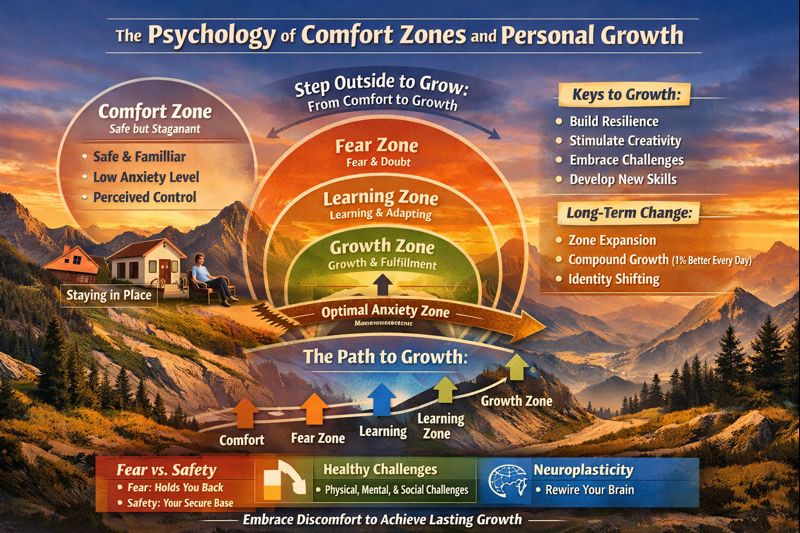
Safe & Familiar: Activities that are routine and present little risk.
Low Anxiety Level: An individual operating within this environment with consistent performance, experiencing little or no stress.
Perceived Control: The environment is predictable and therefore minimizes feelings of vulnerability.
Four Levels of Development—Moving Out of a Comfort Zone
There are four distinctly defined development stages identified in psychology as the comfort zone, the fear zone, the learning zone, and the growth zone.
Comfort Zone: Feeling safe and in control without personal growth.
Fear Zone: Lacks self-confidence, finds excuses for inaction, and is influenced by others’ opinions.
Learning Zone: Building new skills, facing challenges, and pushing their boundaries.
Growth Zone: Understanding one’s self-actualization, developing new purpose, and creating larger ambitious goals.
Reasons to Leave the Comfort Zone
Build Resilience: The ability to adapt and react to unexpected changes.
Stimulate Creativity: As an individual breaks free from the routine of autopilot behavior and begins to use their mind creatively.
Fear & Safety
The importance of fear and the drive for safety have a substantial influence on an individual’s inclination to remain in their comfort zone. The brain’s primary function is to provide for the safety and well-being of the individual; therefore, it is hardwired to choose situations that are familiar or generally accepted as safe and predictable over all other types of situations.
The brain’s response to new or unknown variables is often fear, even in the absence of a real threat, resulting in an individual feeling anxious, doubtful, and hesitant when attempting to face the unknown, therefore forcing them to return to their comfort zone.
Fear and safety are the two most important variables at opposite ends of the comfort zone. Fear determines whether an individual chooses to be stagnant or whether they pursue personal growth, whereas safety is what gives you your starting point (home base) for being able to manage your emotional state.
Fear serves as the alarm system that alerts your amygdala (the part of your brain associated with fear) whenever you enter a situation that is unfamiliar or dangerous. If an individual has total psychological safety, there will not be any opportunity to create new neural connections.
The Fear Zone is where fear creates a barrier to personal growth by instilling feelings of low self-esteem and increased sensitivity to criticism. When an individual is in this zone, they tend to struggle with self-confidence and are often highly sensitive to any type of critique (verbal or non-verbal).
Many times individuals will respond to feedback with behaviors such as becoming fearful or defensive, which often results in a “freeze” response.
Fear often acts as a protective mechanism and manifests in forms such as procrastination or making excuses; both of these behaviors are subconscious ways of keeping the individual in a perceived safe state.
However, as an individual learns to change their mindset from viewing fear as a threat to viewing it as an opportunity for growth, they will be able to develop their ability to adapt and respond to fear-based situations more readily. Becoming able to change your view of physical sensations associated with fear into physical sensations of excitement or readiness is necessary for growth.
Growth Discomfort
Discomfort (e.g., worry, anxiety) when confronted with new experiences is the result of entering into an area that is outside one’s comfort zone.
The initial response to this discomfort is often negative and includes feelings of fear, doubt, anxiety, or stress (although these are important). Discomfort causes the brain to adapt as a response to the new experience (this process is sometimes called brain plasticity).
While it may be that people who avoid discomfort keep their lives relatively stable, those individuals also miss opportunities for personal growth and development (i.e., becoming stagnant). Research has shown that limited levels of discomfort, if properly managed, create confidence, resiliency, and critical-thinking (problem-solving) abilities.
Repeatedly placing yourself in different experiences reduces your apprehension of those experiences and increases your belief in your own abilities. Realizing that growth discomfort is part of the process of growth enables an individual to view it as advancement rather than failure.
A person can experience growth without experiencing extreme levels of discomfort by taking small, deliberate steps beyond their comfort zone. Individuals grow and develop skills through acceptance of discomfort, thereby increasing their ability, resiliency, and ability to attain meaningful personal growth.
A Managed-Stress Approach
Arousal at Optimum Level (the Yerkes-Dodson Law): Peak performance is at moderate levels of stress. Less than moderate levels of stress induce boredom. An excessive level of stress causes panic.
Neuroplasticity Catalyst: Tasks outside your comfort zone develop your brain’s ability to adapt through exposure to new challenges, thus creating a “bigger” comfort zone in the long run.
The “Price You Pay” for Meaningful Change: True meaningful change does not happen without discomfort; the discomfort originates from the requirement to relearn behaviors you currently believe to be safe, as well as to risk failure.
Discomfort: Discomfort can be positive or negative. Healthy or positive discomfort is growth-related and developed through voluntary actions toward self-improvement, versus unhealthy/negatively related discomfort, which develops from involuntary, chronic exposure to stress.
Healthy Challenges
The “Healthy Challenge” concept comprises intentional and controlled adverse conditions that lead an individual to a point of learning (“Learning Zone”), while not triggering a panic response. In 2025 the emphasis of experts and psychologists is as follows for categories of healthy challenges to create resilience and increase neural plasticity.
Core Categories of Healthy Challenge:
Physical Micro-Stressors—↑ Stress Tolerance and Dopamine via intentional and mild physical discomfort, e.g., taking cold showers/water immersion, defaulting to stairs instead of elevators/escalators, and walking 10,000 steps a day.
Digital/Cognitive Detoxing—Create “Screen-Free Saturdays” or “No-Phone at Mealtime” exercises that help reduce instant gratification and encourage creative thinking/proactive problem solving via boredom (i.e., being off of your smartphone/TV).
Skill Expansion—Take a class related to a subject you know absolutely nothing about (e.g. learn to speak a new foreign language, code, or cook in a different style). A class forces the brain into active learning mode.
Social/Emotional Stretching—Work on your social anxiety by complimenting at least one stranger every day on something specific or requesting a peer evaluation for performance. Both of these help develop EQ and self-trust, but they also stretch you emotionally.
Choosing a “Healthy Challenge.”
Check the “Panic Zone.” If you are unable to feel safe physically during a challenge due to heightened or overwhelming feelings of fear, it is likely too intense. Consider reducing it down to a micro-goal.
Long-Term Change
Long-Term Change Occurs through a Steady Process of building growth, persistence, patience, and continual growth. Rather than through an extreme or very quick effort. For example, in personal growth, long-term change takes the form of the use of small, manageable, incremental ways of stepping out of one’s comfort zone (which helps build confidence) to continually develop new skills and create new routines.
You develop your capability by taking on ‘Healthy Challenges’, as you would be able to create new healthy habits through many, many challenges over time. Acknowledging that discomfort, setbacks, and a slow pace are all essential to the long-term growth journey is an important part of having long-term change.
The primary goal of long-term change is to turn into an “effortless kind of habit” what was once a challenging or difficult task; therefore, once this transformation occurs, the individual has expanded their “comfort zone” and is now operating at a new level of capability.
In 2025, psychology’s focus was on the concept of how much difference creating sustainable growth can make and that the way to achieve it is through an “incremental growth process” or an “incremental method” as opposed to a “radical” or “instant change.”
Zone Expansion—By continually putting yourself in the “Learning Zone” through successive healthy challenges, you eventually expand your “Comfort Zone” to where the levels of performance that were once difficult become your “New Normal.”
Compound Growth—An improvement of 1% a day over the course of a year leads to a significant long-term shift. This idea has been used by the field of behavioral science and is sometimes referred to as the aggregation of marginal gains.
Identity Shifting—When you no longer focus on the result of your efforts but instead on who you are becoming as a person, you make the lasting change. For example, instead of saying “I am trying to run,” start saying “I am a runner.”
Neuroplasticity—Regularly challenging yourself protects against cognitive impairment and helps your brain to remain healthy.
Conclusion
Comfort Zones represent the base foundation of comfort and safety within an individual’s life and oftentimes have deep roots within. Comfort Zones ultimately prevent an individual from becoming their best self, and therefore becoming an empowered individual.
When individuals choose not to challenge themselves and try out new experiences, whether because they are fearful of the unknown, or simply desire to remain in a comfortable place, they will be limited in their potential as human beings. True growth will begin to occur once an individual understands that the process of growing will often lead to discomfort, but how an individual reacts to that discomfort will change the nature of that discomfort.
The more individuals learn to identify the fact that being uncomfortable and/or pushing oneself into healthy risk(s) creates new skill sets and increases self-confidence, the larger their skill set will become and the more self-confident they will become. Permanent, sustainable change occurs over time through persistent work, patience, and the small actions taken to step beyond a comfort zone; with every new experience, an individual develops resiliency, self-awareness, and emotional strength.
When individuals learn about the subconscious psychological processes associated with Comfort Zones, it allows them to consciously choose to make better, more deliberate and protective decisions, versus reactive fear-based choices. By learning how to develop a balanced relationship between safety and risk, the individual will position themselves to create and sustain personal growth throughout their lives.