Introduction
As of 2025, the science of behavior has validated that when you want to change your lifestyle, the approach should be based on compounding small ongoing actions, versus a one-time large effort.
The power of consistency allows your brain to rewire itself to make it easier to perform an action consistently over time. You achieve permanent results not due to one event’s power, but because you have successfully completed many small “micro-wins” that created your new psychological baseline.
Most people try to transform their lives by working out really hard at the beginning, using a very restrictive diet for short durations, or attempting to lose weight rapidly.
They’ve all experienced failure because those intense short-duration efforts create burnout, allow for very little, if any, adaptation, and leave them drained of energy and motivation. The critical factor that leads to success is consistency.
With consistent and continual small actions over a period of time, you develop habits that are sustainable.
Sustainable habits are formed through repeated consistent behaviors, whereas your inability to consistently continue a large, intense effort usually leads you to quit.
When you embrace the idea of gradually improving through continual steady effort, you will develop weekly routines that support your health, fitness, work productivity, and personal development while preventing you from overwhelming yourself.
Intensity Trap
The psychological cycle, also referred to as the intensity trap, is a term used to describe how excessive or unrealistic expectations around physical activity create psychological impediments to meeting fitness goals.
The Intensity Trap is recognized by behavioral scientists in 2025 as a key factor contributing to unsuccessful attempts at making lifestyle changes, as such extreme physical efforts do not consider the actual limitations of day-to-day life (i.e., busy work and energy levels), leading people to feel as though they cannot achieve their fitness goals due to these limitations.
The Intensity Trap creates three areas of negative psychological impact:
The Unsustainable Highs: Extreme physical efforts (or “crash” programs) create too much pressure too quickly, causing the body or mind to either physically injure or mentally burn out.
The Shame Cycle: When the intensity of the workout cannot be kept up, it usually produces “thinking traps” where a person feels that since they missed one workout, they have failed and will no longer follow through with the program.
The Difference Between Motivation and Discipline: Intensity is fueled by brief periods of motivation, or “spurts” of energy, while long-term results require consistent effort, or an “engine,” that produces automatic and long-lasting healthy behaviors.
The Intensity Trap also creates another area of negative psychological impact:
A Person’s Ego versus Reality: While the quick boost provided by “Beast Mode” or “Heroic” style workouts may feel good in the moment and make them more appealing to an individual, the individual is not able to develop their body to adapt and become healthy over a longer period of time.
Consistency Science
In order to achieve long-term well-being through the application of daily habits, we need to understand the importance of consistency. We are wired to respond best to regularity in our lives, which means we learn, adapt, and reinforce behaviors through repetition; the more consistently those actions are repeated, the more our neural pathways are created.
Therefore, repeated actions create automatic behavior patterns. Inconsistent and/or intense forms of exercise do not lead to long-term change, as they place additional demands on the body to adapt in order to achieve the same level of activity each time.
Consistency will also help to provide enough motivation and energy levels so that a person will not burn out or become frustrated with inconsistent attempts to achieve the same level of activity.
Studies support that small daily habits, such as walking, meditating, and reflecting, incrementally add up to significant results that are reached over time from as little as one small daily habit added to a daily routine over the course of a few weeks to several months.
The concept of consistency is built upon a foundation of structure and therefore provides an opportunity for individuals to develop all areas of their life, whether that be personally, in a health capacity, or with regard to their ability to effectively manage their time in a productive manner.
By better understanding the science of consistency, we can also better understand what type of behavior will provide the most chance for success, whether that be through continual small changes being made or through developing dramatic changes through short, intense periods of time.
By focusing on the benefits of consistency versus the benefits of intensity, a person can create lifelong lifestyle changes that will sustain their continued growth, well-being, and success throughout their life.
Small Daily Wins
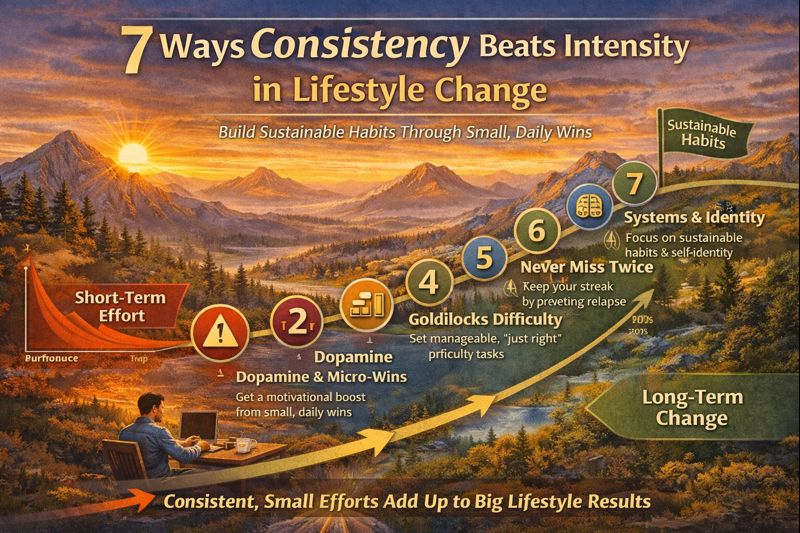
“Micro-Wins” as “Atomic Units” of Lasting Change—Micro-wins (daily successes) will keep you motivated through 2025 and on track to achieving your long-term goals by giving your brain the positive chemical (dopamine) feedback that it craves every time you successfully complete a task.
When you achieve these small daily successes, it will create a “success momentum,” which will help make achieving bigger goals feel like they are going to happen regardless of the resistance in your brain.
Dopamine Feedback Loops—Each time you complete a micro-task (like making your bed or going for a 5-minute walk), you get a dose of dopamine that reinforces the habit loop so you will be much more likely to perform that action again tomorrow.
Goldilocks Difficulty—To achieve consistency in your task completion, tasks must be of “just right” difficulty, meaning that they should be both difficult enough to be meaningful yet achievable enough to do each day, even on your busiest days!
Proof of Identity—Through Micro-Wins, you are taking a step toward becoming the person you want to be. In other words, with each micro-win, you “vote” for the kind of person you want to become. Using these things in combination will change your self-image from “trying” to “being.”
Protection from Burnout—By celebrating and acknowledging small wins throughout high-stress periods, you will avoid the “all-or-nothing” mentality. You are also less likely to quit when you feel you cannot give 100%.
Sustainable Habits
Habitual practices for sustainability are what help people to live through hard days as well as good days.
The focus of Sustainable Habit Development will be on “elastic habits,” habits that flex with your energy levels or ability to implement them.
In 2025 we are already beginning to see the emergence of these habits being used [1].
Low-Floor Entry—For Low-Floor Entry, we will set a ‘floor’ for our habit that is very small, such as doing one push-up or writing one sentence, so that we can keep our neural pathways open and functioning, even during our worst days [1].
Habit Stacking—With habit stacking, we will attach new behaviors to an existing part of our daily routine in 2025, like doing our mindfulness practice while we are making our morning coffee.
This allows us to take advantage of the brain’s existing wiring [1].
Environmental Design—When it comes to environmental design, to help you achieve your desired outcome as easily as possible, we will use specific examples of how removing “friction” will make it easier to achieve desired results.
For example, lay your workout outfit out the night before and place healthy snacks at eye level, thereby making your desired behavior or action the path of least resistance [1].
The “Never Miss Twice” Rule—The “Never Miss Twice” rule is a behavioral standard in 2025 that acknowledges the fact that humans make mistakes but allows us to keep our momentum by preventing any single mistake from turning into a permanent relapse [1].
Long-Term Success
Long-term achievement in making lifestyle changes is a product of many small, continual efforts compounded over time to create sustainable habits and ultimately change who you are.
Instead of relying on an occasional burst of effort that is usually too intense and not sustainable, small, regular daily actions (like 10 minutes of walking or reading one page of a book) reinforce each other and develop a constructive feedback loop, giving you the momentum to keep at it without getting burned out.
Key Principles for Long-Term Success
Celebrating Small Victories: Consistent, little daily actions (like walking 10 minutes or reading one page) develop positive momentum and reinforce one another, creating a positive feedback loop. This momentum allows people to continue on their path to healthier living without the possibility of burnout.
Creating Your Identity through Habit: The greatest long-term changes come from establishing who you see yourself as. Each time you practice a habit, you are “voting” for the person you want to become. Changing from saying “I am trying to become healthy” to “I am healthy” is an example of creating your identity through habit.
Creating New Habits through Neuroplasticity & Routine: Creating new habits using repetition; creating new habits via routine and repetition; creating daily habits consistently leads to change.
Focus on Systems instead of Goals: Depending on a system for dependable daily actions means that you will maintain progress when you lose motivation.
James Clear puts it this way: “You do not rise to the level of your goals; you fall to the level of your systems.”
Be patient and keep trying (grit); understand that meaningful change will take time; many times it can take several months to build a healthy lifestyle, not a couple of days.
Conclusion
The human brain does this through repetition rather than through force; thus, consistency is better than intensity in order to let us both learn asynchronously as we grow and develop into our unique selves over time.
In 2025, a lasting change, or a state of being different, will not come suddenly as the 1st place in a marathon, but instead, much slower as we achieve many small successes (known as ‘micro-win’) along our journey towards the new, optimum me.
By placing greater importance on repeat occurrences than one-shot actions, I am less likely to reach my point of exhaustion with this type of approach and instead can create and strengthen a permanent neural connection between my actions and practice and produce a newly developed habit that becomes automatic or effortless for my new way of living.